Every seat filled.
Every learner asks the same thing before they enrol: what will this course actually cost me? SeatWise answers in seconds, shows the rule behind the number, and books the seat in the same conversation.
No sign-up. The checker below is the live product, running the rules it ships with.
Live, on this page
Real rules, real courses, real seats. See it on a provider site
Check what you would pay
Four questions. The answer updates as you go.
Accredited under IBF-STS
Indicative estimate
Advanced Wealth Advisory
Answer these and the full breakdown appears here: residency status, who is paying, age.
Indicative estimate based on the scheme rules configured by the provider. Final eligibility is confirmed at registration.
A funded seat is lost in the gap between interest and an answer.
The learner is ready. The seat exists. What stands between them is a question your registration team answers by hand, one email at a time.
Answered by email, two days later
A learner asks what they will pay on a Friday afternoon. The answer arrives on Tuesday. By then they have moved on, or the run has closed.
The same explanation, all day
Your registration staff explain the same schemes, the same caps and the same age thresholds dozens of times a week, from memory or from a PDF.
Seats expire with people waiting
Runs go ahead half full while interested learners sit unanswered. The subsidy was never the obstacle. The delay was.
A number, the rule behind it, and a seat. In one card.
Not a paragraph, not a range, and not “up to 70 percent, subject to eligibility”. A designed breakdown that tells a learner what leaves their bank account, and why.
Note the third answer. A question about someone else does not inherit the asker's circumstances, so the assistant asks one more question rather than assuming. Every follow-up recomputes from scratch and renders a new card. Both the number and the sentence explaining it are produced in code.
Indicative estimate
Advanced Wealth Advisory
You would pay
S$840 less, thanks to IBF-STS funding support.
- Course fee
- S$1,200
- Funding support (IBF-STS)70 percent of the fee
- - S$840
- GST at 9%charged on the full fee
- S$108
- Payable to the provider
- S$468
Why this answer
Singapore citizens aged 40 and above receive 70 percent of the course fee excluding GST, capped at S$3,000 per participant per course. Age is assessed at the course commencement date.
Indicative estimate based on the scheme rules configured by the provider. Final eligibility is confirmed at registration.
Next step
20 seats left in the 12 Nov 2026 run.
Caps, stated honestly
A 70 percent rate capped at S$500 is 41.7 percent on a S$1,200 course. SeatWise says so, next to the headline rate.
The rule is named
Each answer cites the rule code, links the official source, and shows the date it was last checked against that source.
Gaps go to a person
When the configured rules do not reach a case, the assistant says exactly that and logs the question. It never invents a number.
The answer is the booking
The seat is booked from the card, at the fee that was quoted, recomputed from the rules at the moment of booking.
The console your registrars actually work in.
Fill rates, at-risk runs, the bookings list, and the two screens that decide whether any of this is trustworthy: a rules editor with a live test panel, and a log of every question the assistant could not answer.
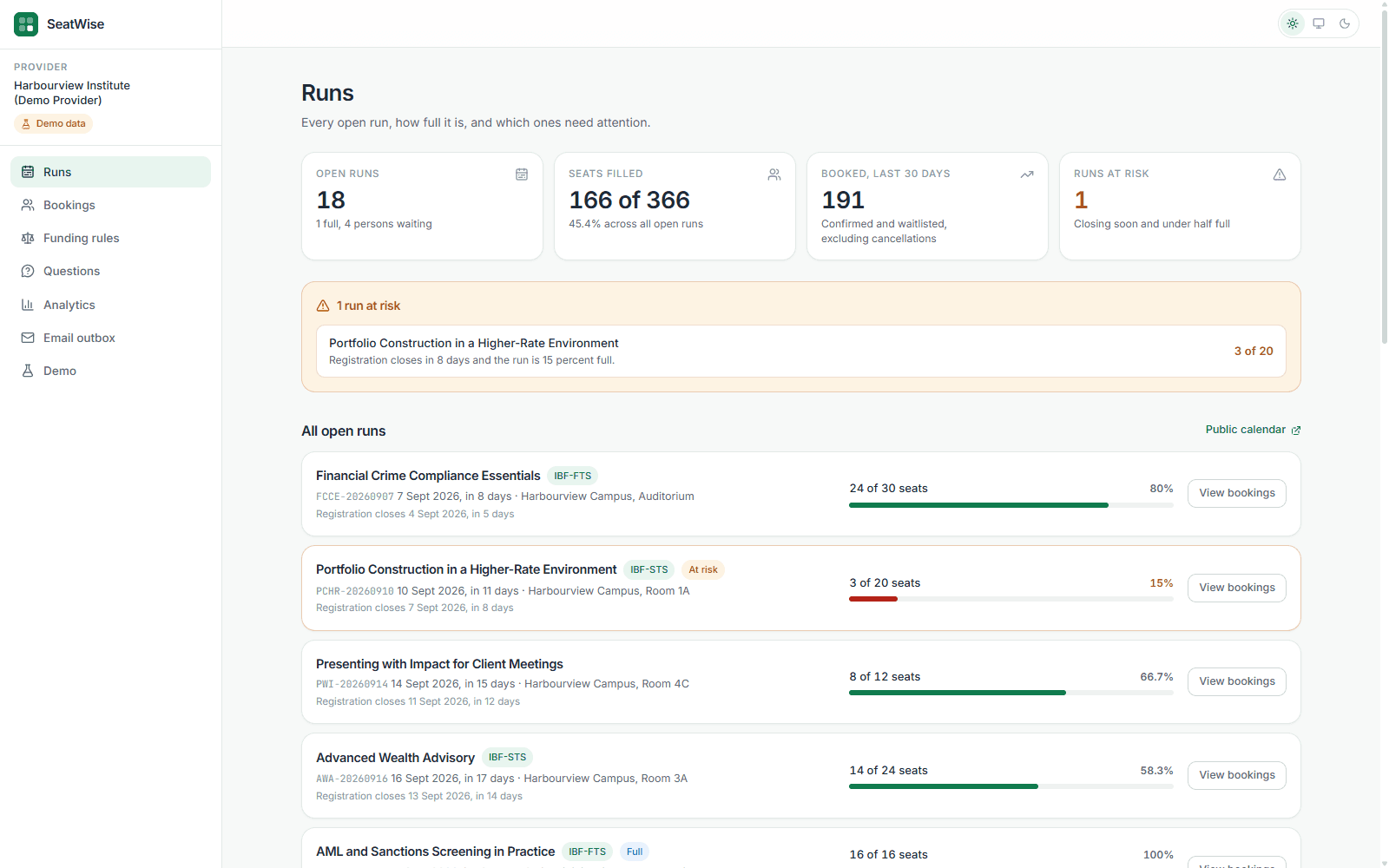
Runs, with fill rates and an at-risk flag
Every open run, how full it is, and the ones where registration is closing while the room is still empty. That list is the difference between noticing a problem and noticing it in time.
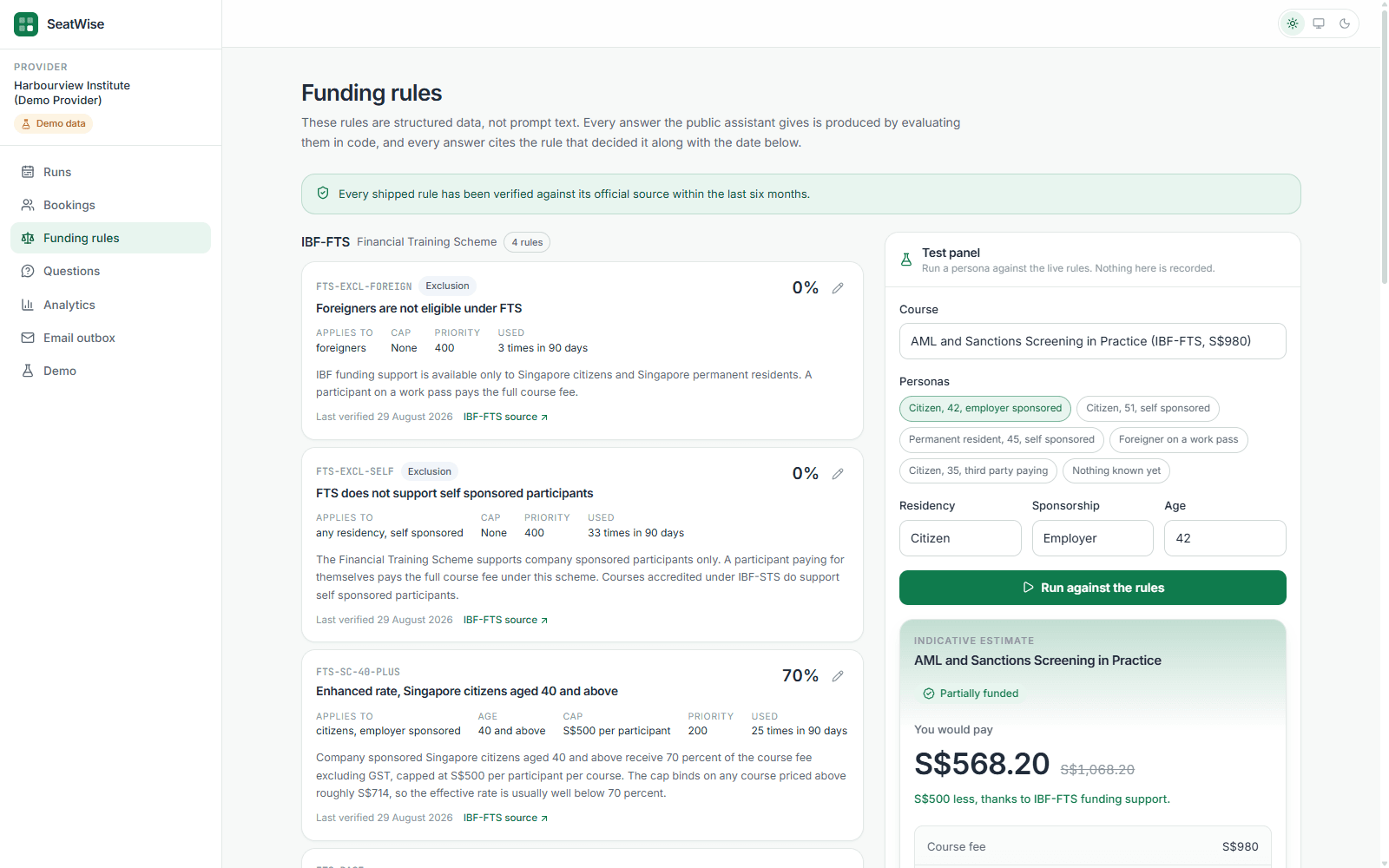
The rules editor, with a test panel
Funding rules are structured, versioned data, each with its source URL and verification date. Change a rule, run a persona against it, and see the answer a learner would get along with the full evaluation trace, before anything ships.
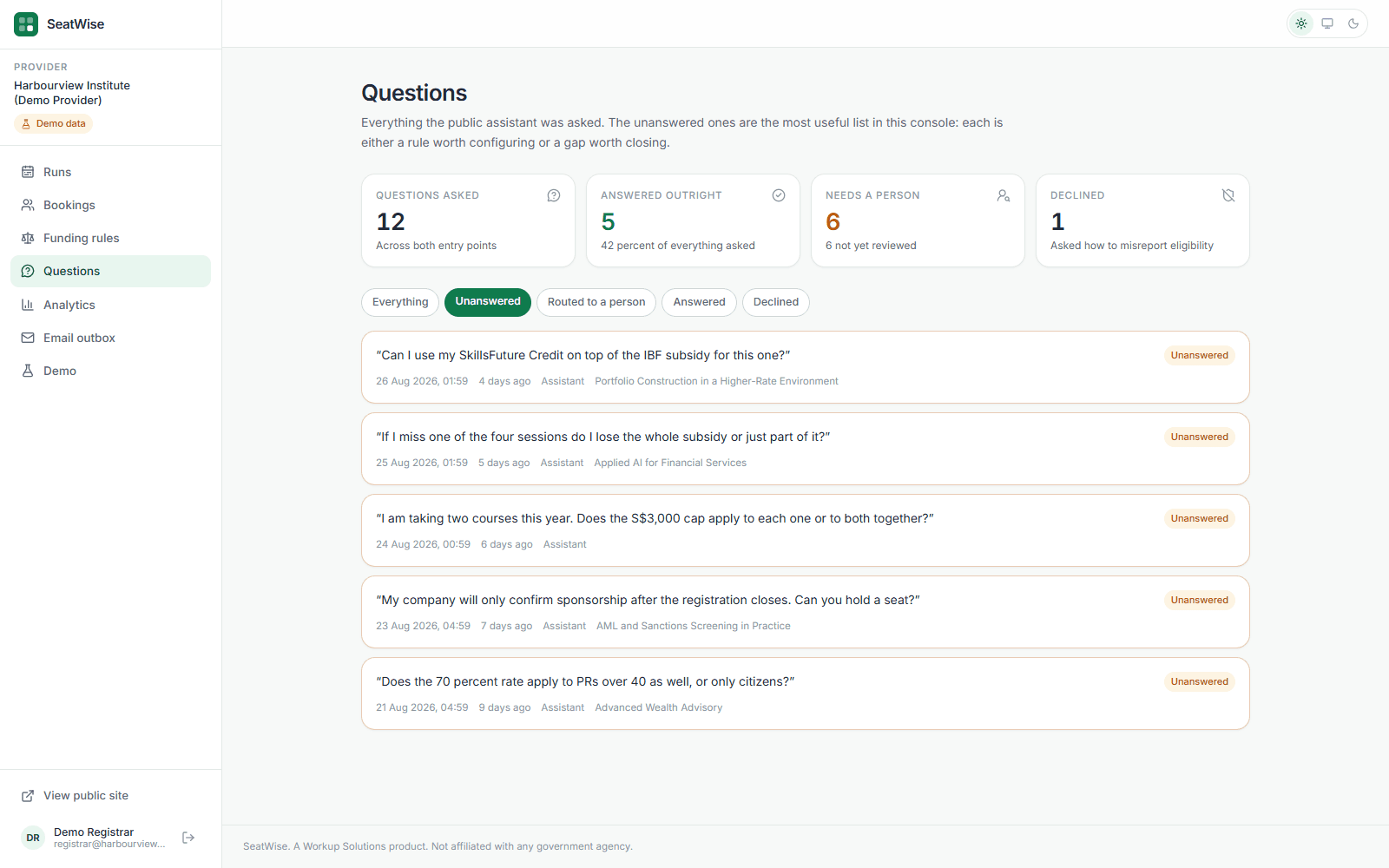
The questions it could not answer
Every unresolved question is either a rule worth configuring or a gap worth closing. Most enrolment systems throw this away. It is the most useful list in the product.
Built so that being wrong is hard.
Quoting a subsidy is quoting money. The whole system is arranged around that being true.
Deterministic computation, not AI guesswork
Eligibility, arithmetic and the sentence explaining the answer are all produced by code, covered by unit tests on every shipped rule. A language model is optional, is limited to reading a learner's words into four attributes, and is switched off in this demonstration. No model can produce, change or override a number.
Rules carry their provenance
Every rule stores the official scheme page it came from and the date it was last verified against that page. Both are rendered in the learner's answer, not filed away in a document nobody opens.
Indicative, and labelled as such
Every answer carries the line "Indicative estimate based on the scheme rules configured by the provider. Final eligibility is confirmed at registration." There is no code path that produces a figure without it.
Unresolved cases reach your team
Where the rules do not cover a situation, the assistant says so plainly, logs the question with the learner's stated circumstances, and routes it. Nothing is guessed to avoid an awkward answer.
Evidence captured when it is cheapest
Declarations that a scheme requires at registration are collected in the booking flow and stored against the exact rule version that justified the price, instead of being chased months later.
Every message is on the record
Confirmations, reminders and waitlist offers are stored with the figures they quoted, so what a learner was told is a fact you can look up rather than a thing you remember.
What SeatWise is not
It is not a learning platform, not a payments processor, and not an official eligibility authority for any government scheme. It computes an indicative estimate from the rules a provider configures, and it fills seats. Final eligibility is always confirmed by the provider at registration.
The engine does not know it is Singaporean.
A funding rule is a set of conditions, a percentage, an optional cap, a source and a verification date. Nothing in that shape is specific to one country. The Singapore IBF schemes ship configured because that is the flagship market, not because the engine is built around them.
- Subsidised vocational training with residency and age tests
- Employer levy and co-investment structures
- Voucher and credit schemes applied after a subsidy
- Provider-specific concession and bursary rules
Multi-tenant from the first line: every course, run, rule and booking is scoped to a provider, so a second provider is configuration rather than a rebuild.
See it answer your hardest case.
Bring the eligibility question your team argues about most. A walkthrough runs it through the rules engine live, then shows you the console behind it.